

The Paradox of Anti-Interventionism and the Normalization of Violence in the Age of Endless War: Trump and the War on Iran

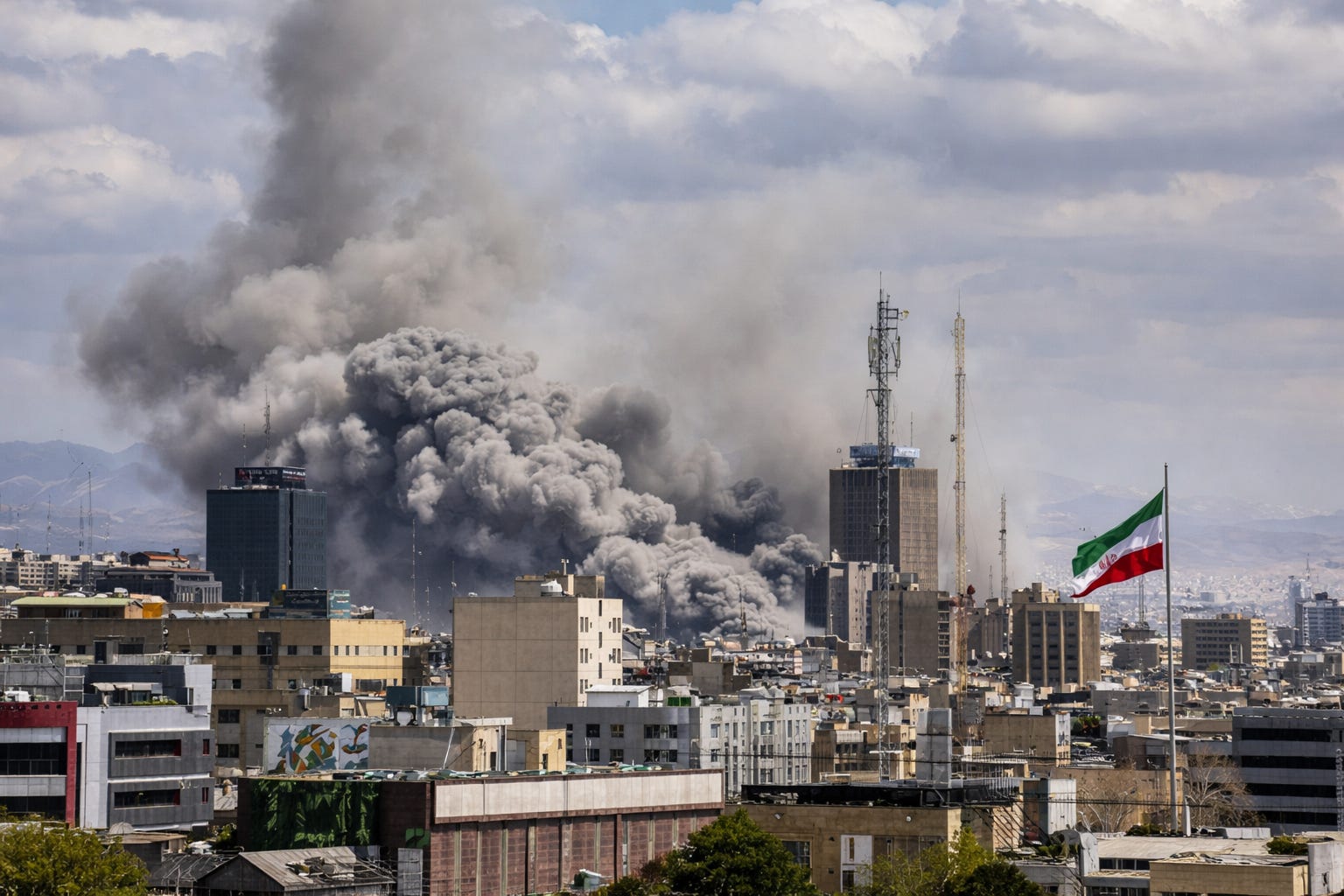
One of the most powerful themes in American politics has been the promise to end the so-called “forever wars.” After decades of conflict in Iraq, Afghanistan, and across the Middle East, many voters—left, right, and independent—were exhausted by strategically unclear and expensive military interventions. President Donald Trump successfully tapped into that frustration. On the campaign trail, he repeatedly presented himself as the president who would finally break with the bipartisan tradition of interventionism. In his election victory speech in November 2024, Trump assured his supporters: “I’m not going to start a war. I’m going to stop wars.”
Yet the reality of U.S. policy toward Iran, and its continuity from one administration to the next, reveals something very different. Instead of dismantling the logic of endless conflict, the trajectory of U.S. policy suggests that the underlying system of military escalation remains firmly in place. For voters who supported President Trump because they believed he would end America’s cycle of war, the result looks less like a break from the past and more like a continuation under new branding.
The central lesson is uncomfortable: campaign rhetoric about ending wars can coexist with policies that move the United States toward new ones, even those that do not directly serve the interests of the American people. Even before considering the broader political implications, the conflict with Iran illustrates several important strategic realities about American power and modern warfare.
First, escalation happens faster than expected. One of the most striking features of the U.S.-Israel war on Iran is how quickly tensions can move from political pressure to open military confrontation. Economic sanctions, covert operations, regional proxy conflicts, and targeted strikes all create a ladder of escalation. Once that ladder is climbed, stepping back becomes politically difficult for leaders on both sides. In other words, wars today often begin long before an official declaration or a large-scale invasion.
The United States has waged an economic war on Iran via sanctions since the Iranian Revolution of 1979, which overthrew the regime of Mohammad Reza Pahlavi, the last Shah of Iran. On February 23, 2026, U.S. Secretary Scott Bessent notoriously admitted that Washington helped spark recent protests in Iran by creating a shortage of U.S. dollars. Yet, economic coercion failed to achieve its intended objective of regime change in a country of 90 million people, and a military escalation followed.
Second, economic shockwaves spread globally. Conflict with Iran carries enormous consequences for the global economy. Iran sits at the centre of a region responsible for a large share of the world’s oil exports. Any disruption - whether through attacks on infrastructure, shipping lanes, or regional allies - surges energy prices. Higher oil prices ripple through the global economy, increasing inflation, straining supply chains, and putting pressure on governments far beyond the Middle East.
Following the US-Israel attack on Iran, shipping traffic through the Strait of Hormuz reportedly fell by 97% due to security threats. Brent crude oil climbed above $110 per barrel, the highest in several years. Economists estimate the war could add 0.6–0.8 percentage points to global inflation.
Third, modern wars are often indirect. Another lesson is that wars today are rarely fought solely between two conventional armies. Instead, they unfold through proxies, cyber operations, economic warfare, targeted strikes, and information campaigns. This type of conflict can last indefinitely because it exists in a grey zone—serious enough to cause casualties and economic disruption, but often below the threshold that would trigger a clear political decision to go to war.
President Trump’s reported suggestion to arm the Kurds served as an excellent example of modern asymmetrical warfare. A day after the U.S.-Israeli strikes on Tehran began, the U.S. President called the Kurdish leaders in Iraq to discuss arming Kurds in order to use the opposition forces against Iran. During his first presidential term, Donald Trump authorised the Pentagon to arm Syrian Kurds in opposition to the Islamic State that had taken control of Raqqa at the time.
Fourth, ending wars is politically harder than starting them. Politicians frequently promise to end wars, but once a conflict begins, the domestic political incentives often shift. Leaders fear appearing weak, allies demand reassurance, and bureaucratic institutions continue operating according to established strategic frameworks. The result is a system that naturally sustains conflict rather than resolving it. On his campaign trail, Donald Trump claimed he could end the conflict in Ukraine “within 24 hours”. As of March 2026, a negotiated settlement remains out of immediate reach, as the Trump administration prepares to put U.S. boots on the ground.
Perhaps the most troubling consequence of decades of continuous conflict is not just the wars themselves, but how societies begin to psychologically adapt to them. When violence becomes routine, events that would once have triggered national outrage are being absorbed into the background noise of geopolitics.
A particularly disturbing example is the bombing of civilian infrastructure, including schools. Reports of “double tap” strikes, 40 minutes apart, hitting an elementary all-girls Shaharah Tahhiba Primary School in Minab, Hormozgan province in southern Iran, on February 28, 2026, illustrate how blurred the lines between military targets and civilian life can become in contemporary conflicts. In Minab, at least 175 people were killed, the majority of them young children. Trump has blamed Iran for the mass killing at Shajareh Tayyebeh primary school, but geolocation, videos, and satellite imagery tell a different story. According to an article published by The Washington Post, a U.S. Tomahawk missile is seen striking the elementary school in a recently released video from the scene. The only three countries known to have Tomahawk missiles are the United States, Britain, and Australia.
Yet, there has been no outrage across the United States in response to the tragic event. In fact, it only made national headlines after a video of a US Tomahawk missile hitting the area of the deadly school attack had been widely circulated online, making it clear that the involvement of the U.S. military or its allies in the conflict is increasingly difficult to deny. The broader issue is the normalisation of such incidents within public discourse: headlines appear, statements are issued, investigations are promised, and then the news cycle moves on.

Once, a tragedy of this magnitude might have provoked massive political backlash in the United States, but now it is just another story in a long list of wartime tragedies. This normalisation is not simply a moral issue; it also has strategic consequences. When civilian casualties become routine, they can fuel resentment, radicalisation, and long-term instability—precisely the dynamics that prolong conflict.
The paradox of President Trump claiming his opposition to foreign interventions and then proceeding to launch an illegal war on Iran, without obtaining the approval of the United Nations Security Council or U.S. Congress, after bombing Yemen, Somalia, Iraq, Syria, Nigeria, and Venezuela since January of 2025, is stark. A political movement built partly on opposition to endless wars helped elect a president who promised a radically different foreign policy. Yet the structural forces that drive American military intervention - the security bureaucracy, alliance commitments, geopolitical competition, and domestic political incentives - remain largely unchanged. As a result, the United States continues to move through cycles of confrontation, escalation, and warfare while the majority of Americans do not support foreign interventions.
For voters who believed they were choosing a decisive break from the interventionist past, this outcome raises an important question: can any president truly end the system of “forever wars,” or has that system become embedded in the way American power operates? Until that question is confronted honestly, campaign promises to end wars may continue to serve less as policy commitments and more as political messaging. And the cycle will continue.
Thank you for your continued support! This site is fully reader-supported, and we are very grateful to our readers. Consider becoming a paid subscriber to World Affairs In Context to support our independent journalism:
"The paradox of President Trump claiming his opposition to foreign interventions and then proceeding to launch an illegal war on Iran, without obtaining the approval of the United Nations Security Council or U.S. Congress, after bombing Yemen, Somalia, Iraq, Syria, Nigeria, and Venezuela since January of 2025, is stark."
The Constitution only addresses Congress to declare war before the President has the right to start any form of war on a country and the War Powers Act does not supersede the Constitution. Even when Congress refuses to do their job and impeach every President who decides he gets to decide who we go to war with and when. The UN Security Council is not binding on the United States and the United Nations is as useless as Congress. You have the United States refusing to sanction Israel for the Palestinian civilian genocide, as an example of how useless that institution is.
Unless there is a good independent or third-party candidate, it is time for all American voters to make their voices heard by not voting. To vote is to give your approval to a candidate. With neither main party caring about the Constitution, not to mention they will spit in your face and tell you it is raining, why would anyone give those candidates their approval? How often do they have to lie to you until you have had enough? The Uniparty wins every election anyway, regardless.
The US does constant wars because this is the only way to prop up the Dollar. We don't produce anything much other than armaments, so we are not an economic powerhouse. Even a recent Ford commercial talked about how many vehicles were "assembled" in America. Not made, but assembled. Translation: There's a lot of imported parts in those "American" vehicles. This is how empires fail; they flail around for quite a while before eventually losing any real power. Look at the British Empire and look at the UK now. They have no power like they once did. Now they are a has-been, but still want to act war-like to try to pretend they really matter much to the world. The world's reserve currency will keep us afloat for awhile longer, but the Treasury and the Fed can only play musical chairs for so long. Look at how long Japan intervened in their economy and they didn't even have a reserve currency. But eventually they had to pay the piper, as will we.
Power is the problem — inordinate power. Not power as in energy, but as in control. The main conduits of power are public, private, and religious. The public is the power of the government. The private is wealth. And the religious is faith and dogma. Often, more than one of these channels is used. Trump has used all three.
Much is written and discussed about world problems, but very little is available as a solution—the solution, though far from simple, is to control power. I would love to see viable solutions discussed.